PRI-724 (Licensing Partner : Ohara Pharmaceutical)
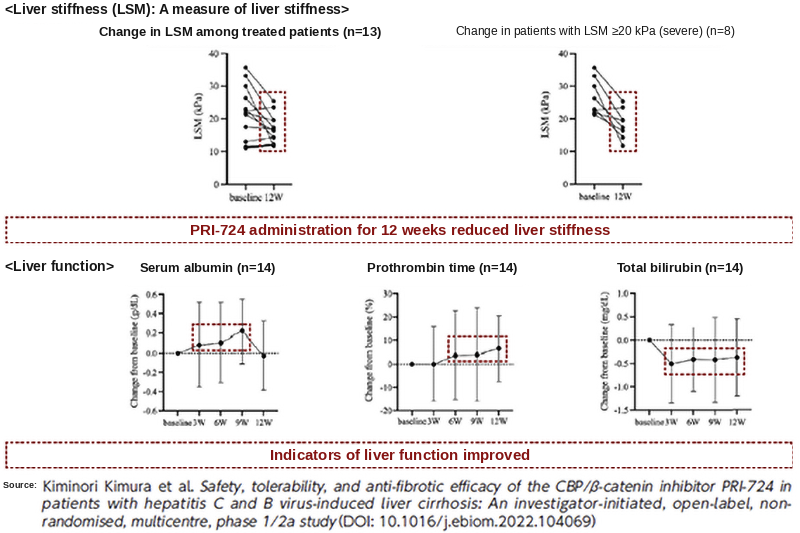
PRI-724 (generic name: Foscenvivint) is a CBP/β-catenin interaction inhibitor discovered by PRISM BioLab. Rights to the compound for non-oncology indications were out-licensed to Ohara Pharmaceutical Co., Ltd. Phase I and Phase IIa clinical studies in patients with liver cirrhosis caused by hepatitis C virus (HCV) or hepatitis B virus (HBV) demonstrated improvements in liver stiffness and hepatic function. Based on these results, proof of concept (POC) was achieved in April 2022. In an interim evaluation under the Cyclic Innovation for Clinical Empowerment (CiCLE) program of the Japan Agency for Medical Research and Development (AMED), the project received a favorable assessment, noting that efficacy had been confirmed in the Phase IIa study, safety concerns were limited, and advancement to the next stage of clinical development was considered feasible, with continued progress expected according to plan. Since April 2023, a Phase II clinical study has been conducted at 38 sites in Japan in patients with decompensated cirrhosis caused by MASH (metabolic dysfunction-associated steatohepatitis; formerly known as non-alcoholic steatohepatitis [NASH]), in addition to HCV- and HBV-related cirrhosis. Patient enrollment has been completed for the MASH cohort. The clinical study is expected to be completed in December 2027.
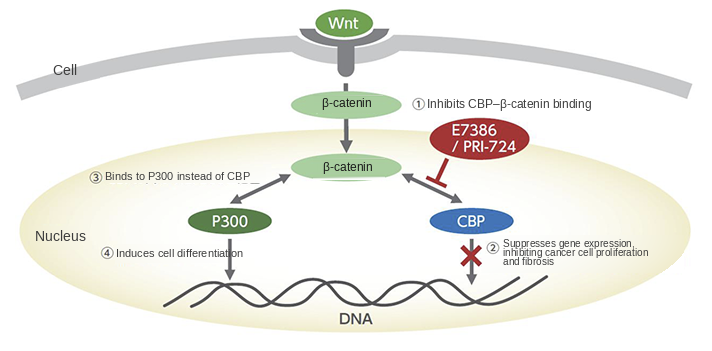
CBP/β-Catenin Interaction Inhibitors
The Wnt signaling pathway is a network of a wide range of biological processes, including cancer progression and fibrosis, and has long been recognized as an attractive target for drug discovery. Because Wnt signaling plays essential roles not only in pathological processes such as tumorigenesis and fibrosis but also in normal cellular differentiation and tissue homeostasis, complete inhibition of the pathway can lead to significant adverse effects. Conventional Wnt inhibitors have generally targeted upstream components of the pathway, resulting in broad suppression of Wnt signaling and unacceptable toxicity, which has limited their clinical development.
E7386 and PRI-724 were designed based on a novel concept aimed at achieving therapeutic efficacy while maintaining an acceptable safety window. ctivation of Wnt signaling requires the binding of β-catenin to the transcriptional coactivator CREB-binding protein (CBP) in the cell nucleus. PepMetics® compounds selectively bind to CBP and inhibit its interaction with β-catenin. Importantly, these compounds do not bind to p300, a closely related protein with functions similar to those of CBP. As a result, β-catenin/p300-mediated signaling remains intact while CBP/β-catenin signaling is selectively inhibited. This selective mechanism enables PepMetics® compounds to suppress pathological processes such as cancer progression and fibrosis without completely shutting down the overall Wnt signaling pathway.

OHARA Pharmaceutical Co.,Ltd.
- Exclusive license agreement in Japan covering PRISM BioLab’s patents and patent rights related to the licensed technology.
- Phase II clinical trial initiated in July 2023 for OP-724, a CBP/β-catenin inhibitor, in patients with decompensated cirrhosis caused by hepatitis C virus (HCV), hepatitis B virus (HBV), or MASH (metabolic dysfunction-associated steatohepatitis).
- Patient enrollment has been completed in the MASH cohort