High Complementarity
Between PepMetics® and AI
PRISM BioLab practices AI-driven drug discovery that relies on structural characteristics of PepMetics® compounds. While PepMetics® compounds possess diverse side-chains, they are built utilizing a defined
number of proprietary scaffolds, resulting in a highly systematic chemical space.
In contrast to conventional small-molecule libraries—where chemical space expands without structural regularity—PepMetics® compounds enable efficient learning of structure–property and structure–activity relationships, making them particularly well suited for machine learning applications.
For that reason, PRISM BioLab integrates AI technologies into molecular design, property and pharmacokinetic prediction, and compound prioritization, combining data science with computational chemistry to enhance both the speed and precision of drug discovery.
AI-Based Prediction of Physicochemical Properties and Pharmacokinetics
PRISM BioLab operates AI-based machine learning models optimized for PepMetics® compounds. Because physicochemical and pharmacokinetic properties depend strongly on molecular structure, experimentally accumulated data across PepMetics® compound series represent highly valuable training datasets.
Using proprietary experimental data, we have established PepMetics®-specific predictive models for properties such as LogD, solubility, membrane permeability, microsomal stability, CYP inhibition, plasma protein binding, cytotoxicity, and hERG inhibition. Each prediction is accompanied by a confidence score, enabling researchers to make informed decisions without treating AI outputs as black boxes.
Application of AI Technologies
to PepMetics® Compound
As an example, the progression of membrane permeability predictions using AI-ADMET models demonstrates that both prediction accuracy and the proportion of compounds with high-confidence predictions have improved as data accumulates. Nearly 80% of PepMetics® compounds can now be predicted with over 90% accuracy—a level that researchers can rely on with confidence.
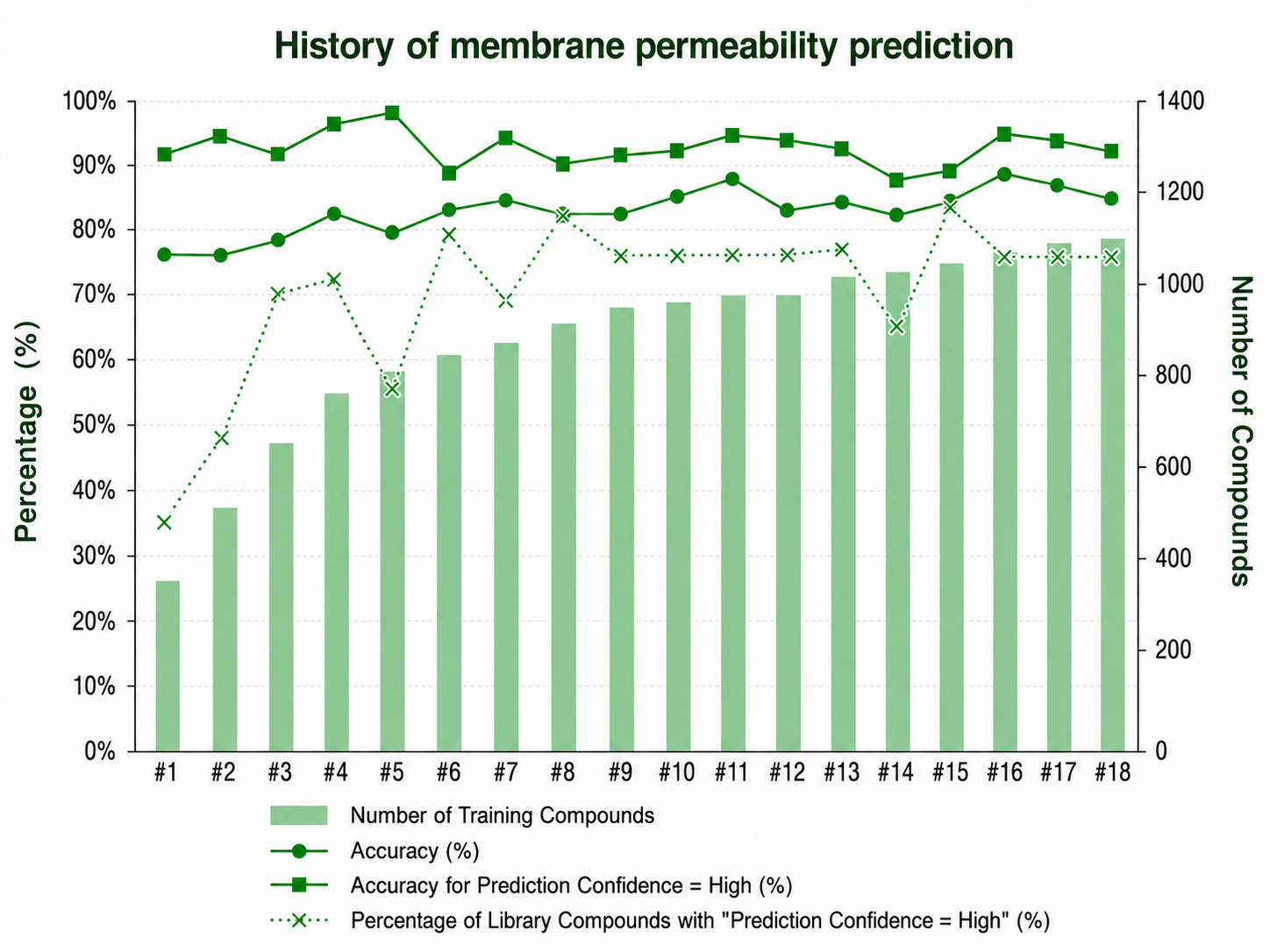
Application of AI technologies to PepMetics® compounds
A: AI-based ADMET prediction; B: Tyrosine side-chain structure generated using generative AI
AI-based predictive models are expected to continuously improve as the volume and quality of training data increase. PRISM BioLab therefore continues to collect experimental data on PepMetics® compounds to enhance model accuracy, support reliable molecular design, and further streamline the drug discovery process.
AI Applications for Lead and
Clinical Candidate Generation
Identifying highly potent compounds is essential for drug discovery success. PRISM BioLab employs AI models that incorporate structural and activity parameters to generate highly active compounds within the DMTA cycle.
PepMetics® compounds are constructed by combining scaffolds and side chains. While libraries initially emphasize side chains derived from natural amino acids to mimic native protein interactions, such side chains are not always optimal for drug development. Starting from hit compounds, side chains are systematically modified to improve drug-like properties.
In addition to human scientific insight, PRISM BioLab actively utilizes generative AI to propose novel side-chain structures with enhanced pharmaceutical value. Through this strategy, we aim to balance drug discovery speed with a high probability of success.
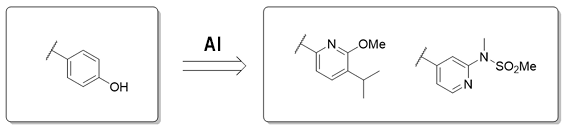
Phenol Conversion
Through these initiatives, PRISM BioLab leverages the high affinity between PepMetics® technology and AI, advancing AI-driven drug discovery through proprietary methods. By broadly exploring and applying the potential of AI, we aim to achieve both precision and speed in drug discovery.